10.21.2008

down the rabbit hole

"The air is on fire,” she said. Her heavy Norwegian accent permeated her words, rippling like birdsong in her speech like the heat that rippled on the skin of the desert engulfing us. We were on the longest road in South Africa without anything on it; no villages, no electric poles, no cell phone reception, and no sound save the sound of our tires scraping the dust road and the whipping of the wind as the car cut through the void. Mountains merged in the distance, unreachable and unmovable, and valleys of sharp black rock and yellow and violet wisps of flowers looped in and around us. The sun was insurmountable, hot and heavy and a sandy yellow. We were driving deeper into the heart of the Great Karoo, no-man’s land, middle of nowhere, down the rabbit hole and into a vortex of surreal experience, radical expression, dreamscape. We were driving to Afrika Burns.

Tankwa Town, a village that sprouts out of the ground for only a week once a year, composed of hippies, drummers, potheads, painters, bakers, dj’s, bar tenders, dancers, and everyone 
in between, is a five hour drive northwest of Cape Town. We took the N1 through harsh violet mountains and tunnels and vineyards and fruit orchards, through Ceres and beyond, taking an off-road, R355, to lead us onward. We hit a sharp rock on the homestretch, busted a tire, and we danced like flower children in the heat of the oncoming summer as Alex changed the tire. We kept driving, took another off-road into a private nature reserve called “Stonehenge,” and landed in the middle of Tankwa Town, our new home for the next two days. We set up camp as the sun began to set and the sky glowed yellow and rose.

The hyper-reality and bizarreness of the first night at this massive radical art festival in the middle of the South African desert threw me off the ground and into a strange, dislocated place. The village was set up in a massive ring, with people setting up tents in different camps. In the middle of the ring was a large, white dome called “The Wish” and the Man, a derivative of the Burning Man in Nevada with a Khoisan twist; the design originated from a San cave painting of multiple people merged into one figure, a symbol of communal experience. He/She/They would be lit on fire Saturday night. But Friday night, we hopped from camp to camp where tents were lit with lights and held bars (Afrika Burns is a gifting community, so everything, EVERYTHING, was free: booze, roti, chai, bread, drugs, fruit, jewelry, postcards, et cetera), trance music, rock music, creative seating, and vibrant dancing people.  I kicked off my shoes and danced in the dust, and the wind picked up and sent yellow and red flags shooting out straight.  Fires burned.  The music was like a carnival, people were dressed for the circus, and the stars pulsed.  When the lemon pie moon floated on the horizon and bounced higher, it illuminated the world with a blue white glow, and we no longer needed our flashlights or torches or hesitant footing to guide us across the desert plain, littered with shrubs and thorns.  We walked confidently across the emptiness.

I woke up Saturday morning when my body became too hot to sleep any longer.  The sun rose fast, and the heat rose faster.  We ate muesli with soya milk, banana, and strawberry jam, and whole wheat bread spread with lime green avo.   And then we ventured out across the camp to explore the art installations and the generosity that our neighbours were releasing to us.  We painted our bodies inside the Wish, 
and I played with the light and the lens. We checked in our egos as the Ego Booth, and emerged from the "Ego Tunnel" with paint marked on our faces like warriors. We were welcomed into tents offering freshly baked bread (they had constructed their own oven) with honey and butter, cool aloe and honeybush tea in shallow white bowls, and small glasses of ginger chai. Children biked by wearing pink wigs and with streamers flapping behind them, calling out, "Marshmallows! Marshmallows!" and handed us a skewer with a line of pink marshmallows stacked on one another. When it became too hot to bear it any longer, we retreated to our camp and had pasta salad with pesto, tomato, chickpeas, and avo. Our tent was sweltering, though, and I knew I could not stay inside all afternoon. I grabbed my book (Salman Rushide's The Satanic Verses) and found the chai tent. I collapsed on their pillows and slept away the heat of the afternoon. When I awoke, they offered me crackers with mussels and tabasco sauce and red wine, and then I returned to my tent as the afternoon began to cool.

The sun began to set and the sound of drums began to rise. I walked over to the drum circle and my friend Sam offered me his djembe. We played for a long time. I could say an hour, I could say 15 minutes. We had no clocks, no watches, no conception of time save the sun and shadows it cast. My hands and arms ached all night afterwards, but it was the most beautiful measure of pain. I returned again to the chai tent where they fed me more chai and vegetable roti, and I returned to our tent to pass out in the cool, dark night with Miriam, who had been feeling unwell. I slept through the music vibrating across the plain and woke to find the most beautiful sight I have ever seen. We did not know how, but far off in the distance, yellow stars were slowly curving into the sky to join the white ones that were burning billions of lightyears away billions of years ago. And they did not extinguish. They created their own constellation of golden luminosity in the black sky.
I woke Miriam and we were silent in awe. We joined hands and started walking in the direction of the stars, caught in rapture at their beauty and curious to break their mystery. When we were only a few hundred metres away, the Man was lit. We kept holding each other's hands and raced towards the Burning Man, closer to the screaming and cheering and dancing. And then we watched all the extremities, the hands and legs and heart and heads scald off the figure, crackle and smoke up. The core, the centre beam, burned for hours. The soul was the last to go.

Lily and I decided earlier to write down our fears and burn them in the fire. She ran up to me once Miriam and I arrived, face flushed and glowing. "Did you burn your fear?" she shouted.

"I lost it!"

"What do you mean you lost it? Find something else to replace it, quick." I ripped a thorny branch out of the earth. We ran screaming at the fire and threw it in, and Lily shouted, "THAT WAS HER FUCKING FEAR!!!"

Miriam and I sat for a long time looking at the roaring fire, watching naked people dancing off in the distant field and dressed in only painted hearts and fairy wings, and stoned people dancing like wild leaves, and sober people sitting and standing and watching the flames, just like us. After we'd filled our eyes and ears and hearts, we danced. And danced. And we kept dancing all night long until the moon rose and long after.

10.07.2008

waiting

Thabo Mbeki resigned his leadership of the dominant ANC (African National Congress) party and his presidency of South Africa on 21 September. Ehud Olmert resigned his leadership of Kadima and his position as Prime Minister of Israel the same day. Many of us in South Africa hoped President Bush would follow suit, but I guess you can't ask for everything.

We can wait. The world has been sitting on its hands for the last eight years, willing the wars in Iraq and Afghanistan to end and oil prices to fall and jobs to reappear and for Americans to get a clue. The spiral keeps tunneling deeper. But if we can learn anything from Africans, it is the refined art of waiting. And I am not only talking about how Africans will stand in a grocery queue for twenty minutes waiting for check out, or sit on the curb for an hour with the rain pelting their head waiting for the bus, or sit in their market stall in silence for an entire day waiting for one customer to glance at wooden elephant statues on display. I am also talking about how Africans will forgive, almost to a fault, everything that has been inflicted upon them, and continue to wait for an improvement in circumstances that may never come. They wait in Khayelitscha and wait for the day their children will live somewhere other than a corrugated tin and wood plank shack that floods during the winter and spring, and they wait for they day when a black woman's ambitions will soar higher than the position of a cleaner. But many black South Africans, at least those with whom I am friends and with whom I have shared conversations, do not seek revenge on the roots of the problem, on apartheid and white Western exploitation. Revenge does not solve anything. They forgive and they progress when they can and wait when they cannot.

And so our country too, the United States, is learning to sit for hours in the rain, waiting for it to evaporate off our skulls and constricted chests. We are not waiting alone, though. That hope and waiting is shared by the world, and especially by Africans. Calm, silhouetted images of Barack Obama are tattooed on street signs, on garbage cans, and on walls. His myth and his symbols stretch out in a network around America. I do not believe in myths; I am too jaded and realistic for that. But I believe in policy, both hard political and economic plans and strategies and soft cultural permeations. The latter is already making headway domestically and globally through visuals and discourse, and the significance and applicability of the former is becoming all too relevant in the last few weeks alone in America. So we can wait. And we can forgive. And we will eventually move forward.

10.05.2008

skipping ahead

We drove back along the coast and through the narrow, windy mountain passes by sunset and sunrise.  The last day, we drove 160 km for twelve hours past clusters of turquoise villages blossoming across burnt green hills, past rows of elongated lumber pines planted perfectly in dotted lines, past people returning and arriving and in between.  We drove over one final mountain pass, climbed a hill, turned a corner and the world opened up to a sheet of human stars enveloping the land, Cape Town lit up by night.  We nearly cried from relief and exhaustion.

Skipping ahead.

The past couple of nights I've gone out to our favourite club, Chez Ntemba, a fantastic place vibrating to South African house, Congolese, American pop, and glistening black bodies.  It's located on Long Street, the place to be night or day, transforming from a world of cafes, boutiques, and bookstores by day to a pulsing hub of clubs and bars and scents of falafel, sausage, tobacco, and beer by night.  I am writing this at 4:30 in the morning, my body collapsed on my bed but my mind still active after spending the night with a huge group of friends from Norway, America, Nigeria, Ivory Coast, Tanzania, Germany, and Burundi.  I love it.

I loved it last night too, when I went out with my girls and was either drenched with sweat in the club or freezing in the wind outside.  After we left the club, we walked to a falafel nook to wait for a few other friends who wanted to dance a bit longer.  We were approached by a slight willow of a boy with his dirty hoodie pulled up over his head and his long eyelashes crowning his wide dead eyes.  Like all of the other homeless children haunting Long Street at night, he approached us with open palms and a soft voice asking for money.  One of the girls gave him a few rands.  I do not like giving money.  Instead, I asked him if I could buy him something to eat.  His face lit up.  We shook hands, my own cupping his small one with overgrown, greenish nails and colourless skin.  His name was Edward.  He was twelve years old.

I followed him through the hoards of people on the sidewalk as he darted through the small narrow spaces between couples and crowds in the same way I used to do when I was too small to be noticed.  He walked into a convenience store, and pointed to the cornflakes on an upper shelf.  I stretched up on my toes to reach a box, pulled it down, and handed it to Edward.  He grabbed a bottle of milk out of the refrigerator.  He looked at the bags of chips, and looked at me, asked if he could get one.  He picked out shiny green bag and said, "It will be for, what do you call it?"  

I responded, "A snack?"  

"Dessert!"  His smile was genuine, but injured.

I asked him how he would be able to eat his cornflakes and milk, and he said he had a bowl and spoon.  I stood in line with Edward beside me and paid for the food.  R27, about US$3.  The cashier put in a gray plastic bag.  I handed it to Edward.  He looked at me in the eyes and said clearly, earnestly, "Thank you."

I said "You're welcome."  He walked out the door before me and evaporated into the night.

I returned to the falafel stop to breathe and talk with my friends.  Aya left the restaurant, came back 10 minutes later.  She said that she had seen an old woman with a gray plastic bag with cornflakes and milk.  She asked the woman, "Is that boy your son?"  The woman said she had no idea what Aya was talking about.  Aya responded, "You took that food from that boy!"  The woman stuttered, insisted that a woman had just bought it for her.  Aya told me this story.  I nearly screamed.  Maybe I did scream.  In moments of anger it's difficult to determine the volume of your own voice.

I hate that children are roaming the alcoholic streets like rats at 3 in the morning.  I hate that it's cold outside and they don't have any warm clothes to wear.  I hate that I was wearing black suede boots and a low-cut black dress with a sash and dark kohl on my eyes with a jacket wrapped warmly around me.  I hate that they are begging for money and food.  I hate that my belly was full of Savanna Dry cider and tapas.  I hate that we berate them for poor manners when they keep pestering us for money we do not give.  I hate that they are all black.  I hate that they are too small to defend themselves.  I hate that someone bigger and meaner can come by and rip generosity out of their cold hands.  I hate that I didn't buy something that Edward could have eaten immediately.  I hate that Edward did not choose candy bars but chose something healthy, something that would provide meals for the next several days.  I hate that Edward lied to me and said he attended school to appease me.  I hate the system that pushes children into this world with no escape route, no white flag.

9.23.2008

in the search of great art

We left Swaziland and drove through Kwazulu-Natal to make it to Drakensberg Mountains on the border of the country of Lesotho (less-OO-toe), a country contained within South Africa.  The distinctions between this part of South Africa and the country from which we had just ripped ourselves away were few.  Men and woman walked in the hillsides and along the road with long, ten metre stacks of reeds and lumber piled on their heads.  Zulus and Swazis will really carry anything or their head: buckets of water, an axe, produce.  We passed flocks of people waiting at unmarked stops along the road, anticipating a minibus that would take them home for the day.  We passed rows of people walking along the road from the farm, from school, from cleaning, from the hills.  We waved and they would wave back with broad smiles, toothy and toothless.

We made it into Drakensberg after the sun set, and stayed in a cozy B&B where a lovely woman named Baby made us fried eggs, sausages, and thick slices of toast with butter and jam the next morning for breakfast.  She was a master knitter and sewer, and showed me the wool cardigans and cotton jumpers and button-down shirts she created to give to local workers who needed them.  Her designs were flawless and precise, practical and durable.  I was awed by her generosity and grassroots contribution to enable the struggling working class in South Africa (the unemployment rate here is 50%), a race and class she had probably been taught to fear and hate as a white girl in this country.

It was Wednesday.  We made it to a nature reserve called "Giant's Castle" after a two hour drive on thin strips of road through isolated township communities set in dry, grassy hills.  Once we got near the reserve, we spotted springbok and baboons from the road.  Megan and I 
hiked for over an hour by a clear gurgling stream and we finally arrived at the end of our long drives, our long walks, our aching anticipation.  We found ourselves in cool, dark caves with
 alizarin and ochre and white and umbre cows, people, and mythical characters painted on the walls by healers from over 5000 years ago.  The artists were San, or Bushmen, hunter-gather communities who blackened the roofs of these caves with fires for cooking and warmth, who surrounded their transitory space with images from their lives, dreams, and trances.  There were black people lined in a patterned row, a person handing another person a baby, three golden cows predominating one slab of rock.  There was a snake, people dancing, people running, people fighting.  My favourite was a half-man, half antelope with three antelope heads, and a tail with a line of white dots.  An image from a dream or an ancestor.  I had not expected to see work so precise, with each mark so carefully planned and permanent, and to see images so fully developed in imagination and spiritual maturity.  I have seen great art painted on the walls of the Sistine Chapel, but in its own way, this art painted on the walls of caves is just as irreversible and important for its testament to the human capacity to stretch itself in all ways to create something, to leave a mark of its existence in relation to something or someone supreme.

9.22.2008

smoke and markets

The heat and the wind set the fields aflame. After crashing at a nearby hostel, Meg and I drove to a restaurant for dinner and we passed a patchquilt of hot white and yellow fires in the distance and right beside the tarmac. The electricity across the region was out because of the wind, and we took showers that night by candlelight. Lying in my bunk bed, nestled in a sleeping bag, I looked outside the window and watched tongues of flame engulf a banana tree then become quiet again, watched dots of light smolder in the adjacent hill. Showers of sparks would drift across the field like fireflies. Even when a tree on the hostel property exploded like a bomb in jets of gas and heat, I was not frightened. Everyone was calm, treated the fires as a common occurrence. Which it was.

I woke up smelling like smoke, and looked outside to see a heavy fog laying across the dull lit world. Except it wasn't fog. It was all smoke. Snow white ashes slid off the glass of our car door when we opened it. Gray ash settled in the corners of our eyes. Some fires still sputtered.

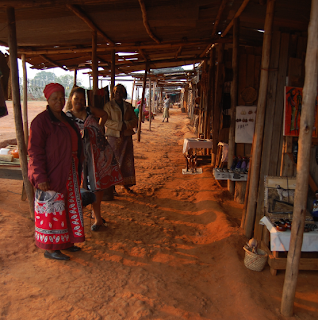
It was Monday. We drove through smoke and rows of pineapple and sugarcane. We set out to explore markets, and found beautiful communities with jacaranda trees and markets set in a tree house. The smoke eventually dissipated and we ventured farther and found another market made from planks of wood lined beside the highway. Each vendor had her own small square of space to sell her goods in this long row of grass baskets, patterned cloth, and beaded bracelets.  The markets were mostly run by women, and it seems that women across 
the world are masters at guilt trips.  Male vendors in Cape Town and Durban will entice you into their shop by showing you a nice carved elephant, a lovely necklace for the pretty lady, promising "a special price for a special customer!"  Women vendors, in contrast, entice 
you into their shops by calling from the entryway, "Please, sissy, just a look.  Just come in and look.  My children are hungry and no one is buying."  One woman even went as far as to say, "We depend on the white people.  The white people haven't been coming."  I felt awful to contribute to this cycle of dependency these woman have on white tourists, because I want them to be able to support their families through sustainable farming, responsible family planning, and selling their handicrafts at fair prices.  Instead, I bought a hand-stitched quilt for the equivalent of USD 25.  I bought a string of beads for 80 cents.  A grass basket with dark and light geometric patterns for USD 5.  And I negotiated down to these prices, insisted that anything higher was exploiting me, the rich white girl.

And then I met Lungile, a wise, beautiful, spirited woman running her own market stall.  We talked for over an hour sharing stories about life, being a woman, laughing with each other and eventually exchanging numbers and addresses.  When I returned to the market the next day 
to say goodbye before we left Swaziland, we talked again for three hours.  After developing these rich friendships with Dumisani, who named me "Fikile," meaning "just arrived" in SiSwati, and with Lungile, who calls me her "American sissy," it was difficult to pull ourselves away from Swaziland.  It is a country with many, many problems of poverty, political corruption, the proliferation of AIDs, and social and gender inequality.  News stories would suggest that the country is utterly helpless in the face of such dire crises, and even Steve Colbert would suggest in a recent skit that Swaziland (and Africa in general) lacks any moral code and Africans are unable to constrain their primitive carnal nature, as evidenced by the thousands of "bare-breasted virgins" parading before the king.  (Note: Reuters, as cited by Colbert, is incorrect in claiming that the Reed Dance was started in 1999 by King Mswati.  I conversed with women in their sixties who remembered their own experiences as maidens in the Reed Dance, and have discussed it and researched it further in my course on African Religion; it is indisputable that the Reed Dance is a very old tradition.  Furthermore, the breast as a sexual object is a Western perspective that is relatively new in African and especially Swazi culture.  In precolonial culture, the breast was not considered something sexy and shameful to be hidden away from the public eye.  It was a part of female reproduction and a symbol of fertility to own and be proud of, still visible in young Swazi women's comfort with their bodies in the Reed Dance.  Other cultures place equal sexual connotations on other body parts, like the ankles or the nape of the neck, and so we must remember that the breast, by nature, is not a sexual object; it is our culture that has defined it as such.  It is a mammary gland.  For my male readers: Really?  You find a mammary gland sexy?)  We cannot and should not pass judgments so quickly on people we have never met or seen, as based upon secondary reporting from biased sources.  In my experience, I have never felt so embraced by a people in my life.